When the Story Begins with an Object
It didn't start with a document.
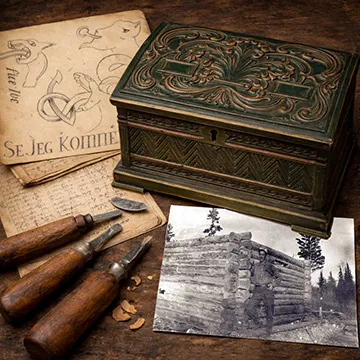
There was no diary, no bundle of letters, no detailed memoir passed down through the family. Instead, the story began with an object—a small piece of wood shaped by careful hands more than a century ago. It had been kept, moved, and protected through generations, valued even when its full history was no longer remembered.
At first, it was simply a family heirloom. Then it became a question.
Who made this? Where did the skill come from? Was it something learned at home, through a trade, or through formal training? And perhaps most importantly—what did this object reveal about the life behind it?
When the Written Record Falls Silent
As the research unfolded, a pattern became clear. For this woodcarver—and for many immigrants of his generation—there was very little written record of the person himself. Census entries listed an occupation. Church and civil records marked the milestones of birth, migration, and death. But there was no personal voice. No explanation of ambition, training, or artistic interest. No description of what mattered to him or how he saw his work.
What survived instead was what he made.
That realization shaped the entire project. The carved box, the drawings, the tools, and the later pieces created by family members were not just keepsakes. They were evidence. They revealed skill level, design influence, and familiarity with formal patterns. They suggested exposure to technical or artistic instruction. They reflected aesthetic choices carried from Norway and adapted to a new environment.
In the absence of writing, craftsmanship became biography.
Why Objects Survive
This is not unusual. Most immigrants in the late nineteenth and early twentieth centuries were not people who left extensive personal papers. Many had limited formal education. Long working hours left little time for correspondence or reflection. Even when letters were written, they were often lost over time—discarded during moves, separated from the family, or abandoned when later generations could no longer read the language.
Objects, however, were different. Useful items were kept because they were needed. Well-made items were kept because they were valued. Beautiful items were kept because they were admired. Over time, these practical and decorative pieces became heirlooms, surviving long after the written record had disappeared.
And those objects carry information that documents rarely preserve. The choice of materials. The level of finish. The design vocabulary. The balance between traditional forms and American influences. Each piece reflects training, experience, economic circumstance, and cultural identity.
Work as Identity
For working people especially, identity was often expressed through labor and skill. A carpenter’s joinery, a carver’s ornament, a painter’s decorative style—these were not hobbies. They were the way a person worked, contributed, and defined competence and pride. In many cases, that work is the most personal record that remains.
As the woodcarver’s story took shape, the focus shifted beyond a single individual. The research began to explore the broader world that shaped him: technical education in Norway, the role of design schools, the value placed on hand skill, and the cultural environment that encouraged both practical craftsmanship and artistic ambition. Migration did not erase those influences. Instead, they continued—sometimes quietly—through work done at home, through later family projects, and through renewed interest in traditional arts.
More Than an Heirloom
Seen in this light, the carved box was no longer just an heirloom. It was a starting point for understanding how skill travels across oceans, how culture survives without written explanation, and how family memory is often carried in wood, paint, and pattern.
The experience also highlights a larger truth about immigrant history. The lives of professionals, writers, and community leaders are often preserved in documents. The lives of ordinary workers—the majority—are not. For them, the historical record may consist of little more than a name on a passenger list and an occupation in a census.
But if something they made survives, their story becomes richer. Their training becomes visible. Their cultural background leaves a trace. Their standards of workmanship, their sense of design, and their connection to tradition remain tangible.
When Hands Tell the Story
In many families, the most detailed personal record is not written at all.
It sits on a shelf. It hangs on a wall. It rests in a drawer, carried forward because someone recognized its value—even if they didn’t yet know its story.
This woodcarver project grew out of that kind of recognition. What began as a single object became an exploration of training, migration, cultural continuity, and family memory. The full study brings together archival research, historical context, and material analysis to reconstruct a life that left few written words but a lasting physical legacy.
Sometimes the past speaks most clearly through what hands have made.